
Overview
- Primary topic
- EN 16612
- Engineering basis
- Structural glass design
- Review status
- Project-specific verification required
EN 16612 Limit-State Design
EN 16612 is used for glass panes subject to lateral actions, including facade glazing, rooflights, balustrade panels, screens and partitions. Applied actions and combinations must be established separately; the glass load-combinations guide explains how VitraLab uses EN 1990 for combinations and EN 16612 for the glass response.
ULS Stress Checks
Ultimate limit state review focuses on design stress under the relevant load combinations. The calculated stress should be compared with the resistance basis used for the selected glass type, load duration, and project assumptions.
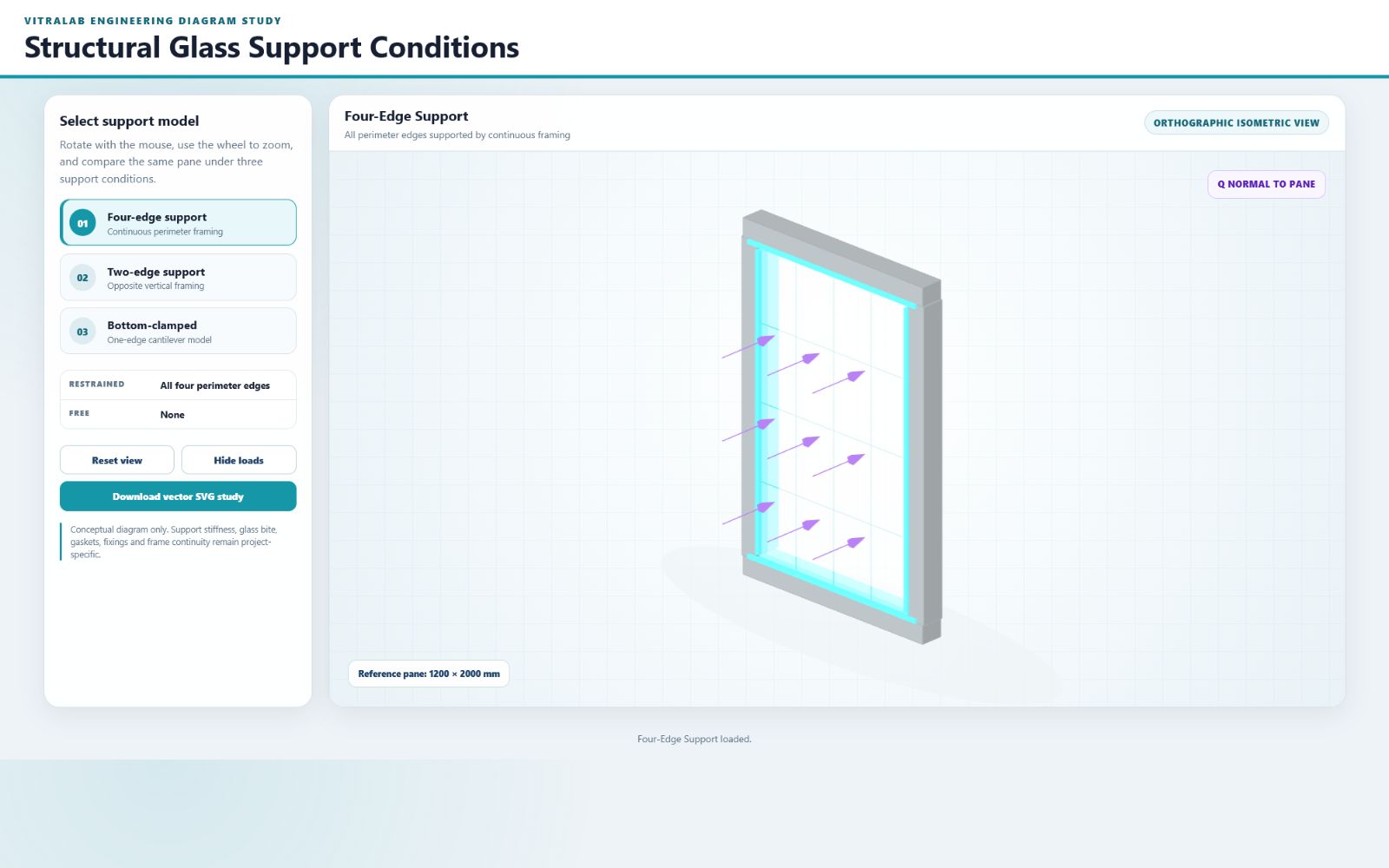 Interactive engineering guide
Structural Glass Support Conditions
Compare four-edge, two-edge and bottom-clamped glass support models in an interactive isometric view.
View support models
Interactive engineering guide
Structural Glass Support Conditions
Compare four-edge, two-edge and bottom-clamped glass support models in an interactive isometric view.
View support models
Design Checks
SLS Deflection Checks
Serviceability limit state review focuses on pane movement under service loads. Deflection can govern even where stress is acceptable, especially for larger panes, horizontal glazing, rooflights, and visually sensitive glazing.
Load Duration and kmod
Glass strength depends on load duration. Wind, barrier, maintenance, snow, and permanent actions may use different duration factors, so the governing stress check is not always controlled by the largest numerical load.
Applicability
Laminated and Insulated Glass
Laminated glass uses an action-dependent equivalent-thickness basis, while a DGU requires review of load sharing between its panes. Pane thickness, interlayer assumptions, cavity behaviour, supports and calculation route can all affect the governing result.
Glass Calculator Output to Review
The EN 16612 structural glass calculator reports pane size, build-up, support condition, governing combination, ULS stress, SLS deflection, utilization, warnings and status. Engineers must still confirm the project specification, load basis, National Annex inputs, supports and applicable local requirements.
Frequently Asked Questions
What is EN 16612 used for?
EN 16612 is used to review structural glass panes for stress and deflection under relevant actions, support conditions, pane dimensions, and glass build-ups.
What are the EN 16612 limit states?
ULS reviews glass strength through design stress and resistance, while SLS reviews serviceability through pane deflection and the selected project limit. The governing action or pane can differ between the two checks.
Does EN 16612 cover both ULS and SLS checks?
Yes. A practical glass design review normally separates ultimate limit state stress checks from serviceability limit state deflection checks.
Why does load duration matter in glass design?
Glass strength is affected by how long a load acts. A short wind gust and a longer-duration load can therefore use different modification factors.
Can EN 16612 software replace project review?
No. Software output should be treated as calculation support and reviewed against project requirements, support details, load assumptions, and applicable local requirements.
Can software output replace engineering judgement?
No. Calculator output should be reviewed against the project specification, support details, load assumptions, National Annex values, and applicable local requirements before final use.
Engineering content is prepared and maintained by VitraLab Engineering. Worked examples show how the current calculator treats a defined case; they do not replace project-specific verification.