
Overview
- Primary topic
- Eurocode 10
- Engineering basis
- prEN 19100
- Review status
- Project-specific verification required
Draft Standard Basis
The implemented engineering basis is drawn from the reviewed 2024 drafts of prEN 19100-1 and prEN 19100-2. The documents may change before final publication and adoption. VitraLab identifies its calculation routes and review boundaries so draft-based output is not mistaken for certification or final-standard compliance.
Single Pane Glass
The calculator supports monolithic and laminated Single Pane glass under the implemented plate-response routes. It reports action combinations, response method, design actions, stress, deflection, resistance utilization and governing results for engineering review.
 Interactive engineering guide
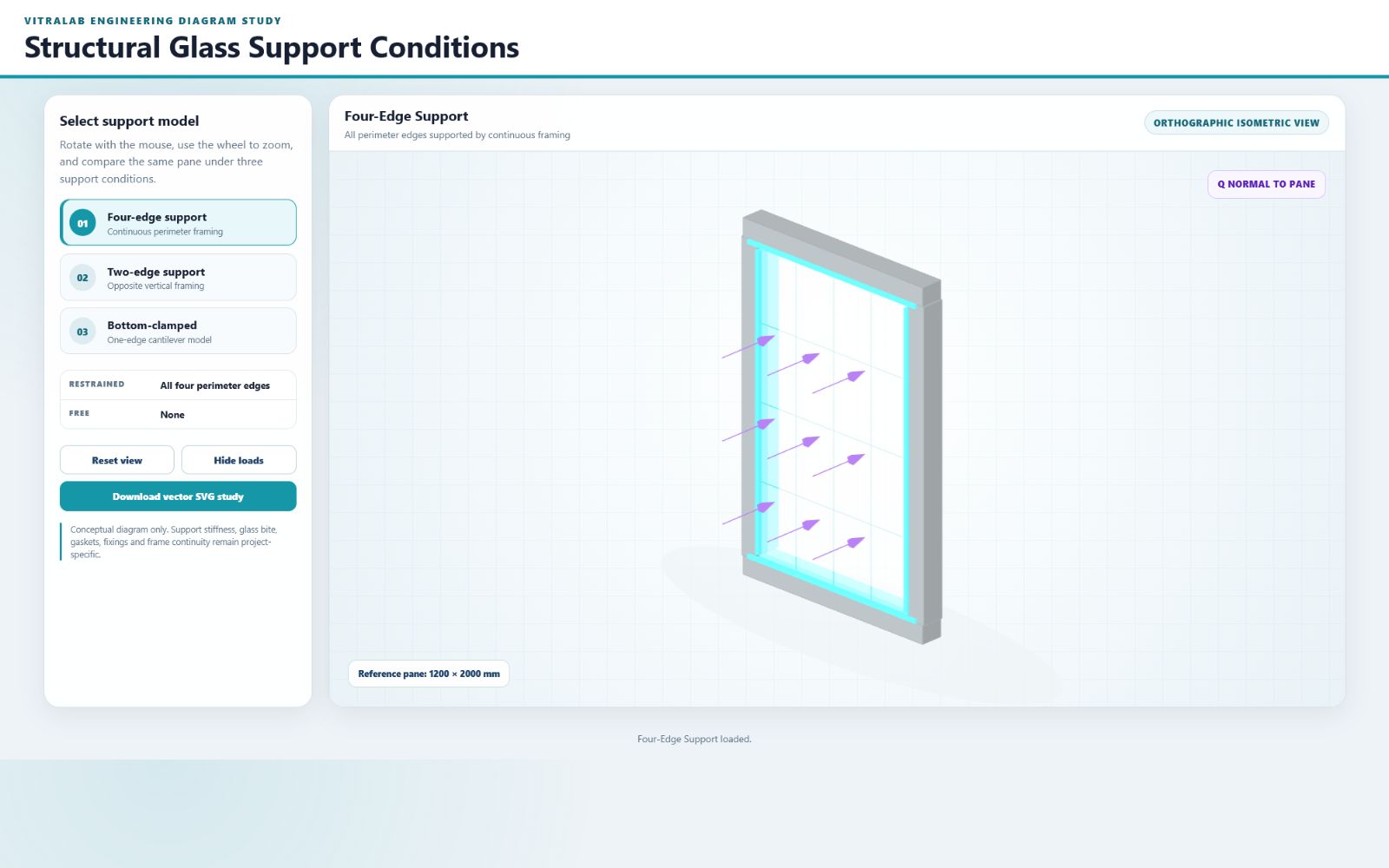
Structural Glass Support Conditions
Compare four-edge, two-edge and bottom-clamped glass support models in an interactive isometric view.
View support models
Interactive engineering guide
Structural Glass Support Conditions
Compare four-edge, two-edge and bottom-clamped glass support models in an interactive isometric view.
View support models
Current Scope
Laminated Glass EET
For double and triple laminated panes, the implemented equivalent-thickness method uses an action-specific interlayer shear modulus to determine coupling, stiffness and ply stress. Calculated or Partial Shear results can be compared with Full Shear and No Shear scenarios.
DGU and TGU
Double and triple glazing calculations treat every pane and cavity as part of one insulating-glass system. Mechanical actions are distributed through the implemented prEN 19100-2 Annex C rectangular-IGU calculation route, with pane-specific stress, deflection, resistance and governing results.
ULS and SLS Review
Ultimate limit state output combines calculated pane stress with the implemented glass resistance basis, load duration, action condition and design situation. Serviceability output reports deflection and the applicable deflection ratio separately, because stress and deflection can govern different panes or combinations.
Natural Frequency
Optional natural-frequency checks are available for Single Pane, DGU and TGU configurations using the implemented prEN 19100-2 Annex B basis. Laminated configurations reuse the relevant action-specific coupling inputs and report the selected, Full Shear and No Shear comparisons.
Engineering Review
Annex C Environmental States
For DGU and TGU, the calculator can report standalone altitude, pressure and cavity-temperature states within the implemented Annex C boundary. They are kept separate from ordinary mechanical load combinations and require project-specific engineering review.
Professional Calculation Reports
The separate EC10 reporting system records project inputs, calculation basis, governing results, action routes, laminated coupling data and applicable IGU or natural-frequency output. Reports are calculation support and must be checked against the project specification and applicable requirements.
Current Scope and Engineering Review
VitraLab implements the calculation scope that has been reviewed and validated in the current codebase. It does not claim complete coverage of every clause, geometry, support condition or future revision of prEN 19100. Engineers must confirm loads, National Annex values, materials, supports, product data, approvals and regulatory requirements for each project.
Frequently Asked Questions
Is the VitraLab Eurocode 10 calculator based on prEN 19100?
Yes. The current EC10 calculator is based on the reviewed 2024 drafts of prEN 19100-1 and prEN 19100-2 within the scope identified by VitraLab.
Is prEN 19100 a final published Eurocode?
No. The documents used for the current implementation are drafts and are not yet a fully published and adopted Eurocode 10. Requirements and numbering may change before final publication.
What glass configurations are currently supported?
The implemented scope covers monolithic and laminated Single Pane glass, DGU and TGU mechanical actions, laminated equivalent thickness, selected Annex C IGU calculations and optional Annex B natural-frequency calculations.
Does the calculator prove compliance with Eurocode 10?
No. It provides draft-based calculation support for engineering review. It is not certified software and does not establish compliance with a final or nationally adopted Eurocode 10.
Will VitraLab review the final published standard?
Yes. The calculation scope, terminology, factors, references and reports will need to be reviewed against the final published and adopted documents when they become available.
What should engineers verify before using the results?
Engineers should verify the applicable project standards, loads, National Annex values, support model, glass and interlayer data, product approvals, boundary conditions and all reported engineering-review notes.
Engineering content is prepared and maintained by VitraLab Engineering. Worked examples show how the current calculator treats a defined case; they do not replace project-specific verification.