
Overview
- Primary topic
- Eurocode 10
- Engineering basis
- prEN 19100-2
- Review status
- Project-specific verification required
What Glass Natural Frequency Represents
Natural frequency describes the rate at which a glass pane or insulating-glass assembly tends to vibrate in its first mode after disturbance. The reported n1 value depends on geometry, stiffness, mass and support conditions. It is not a load, resistance or utilization value.
Single Pane Monolithic Glass
For a covered monolithic Single Pane configuration, VitraLab evaluates the implemented Annex B Formula B.1 route using the pane dimensions, physical glass thickness, material properties and support coefficients. The calculation is optional and appears only when Natural Frequency is selected.
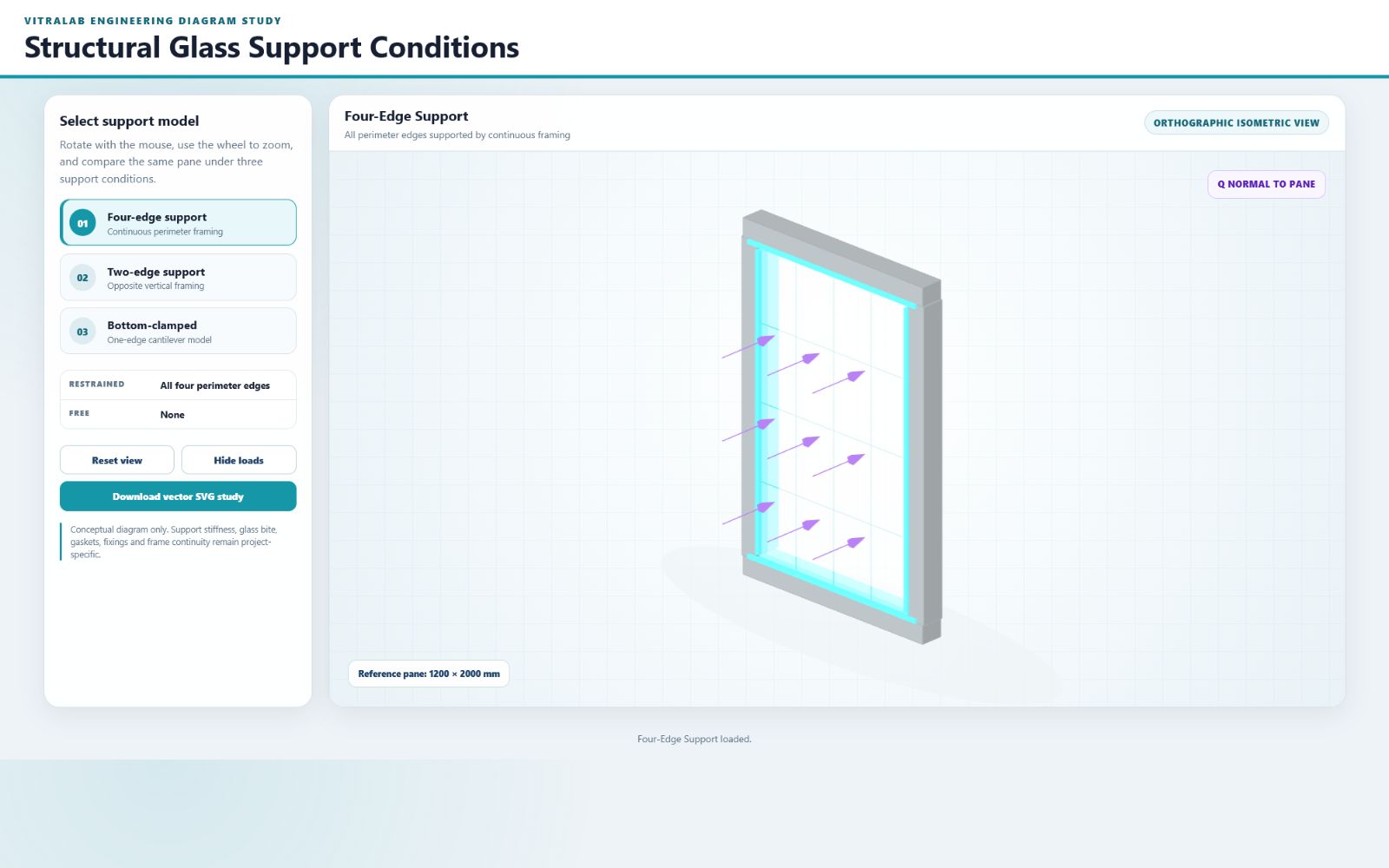 Interactive engineering guide
Structural Glass Support Conditions
Compare four-edge, two-edge and bottom-clamped glass support models in an interactive isometric view.
View support models
Interactive engineering guide
Structural Glass Support Conditions
Compare four-edge, two-edge and bottom-clamped glass support models in an interactive isometric view.
View support models
Annex B Method
Laminated Glass Apparent Density
Laminated Single Pane calculations include every glass ply and interlayer in the physical mass. The implemented Formula B.2 basis uses the complete laminated thickness and requires an interlayer density when the optional check is selected. VitraLab does not assume one generic interlayer density.
Action-Specific Laminated Stiffness
A laminated pane can have different stiffness under different action durations and temperatures. Natural Frequency therefore reuses the active action-specific Gint routes and reports Calculated or Partial, Full Shear and No Shear comparisons for each active category.
DGU and TGU Equivalent Properties
For DGU and TGU assemblies, the implemented Formula B.3 route uses the IGU equivalent thickness and apparent density. Formula B.4 assembles the pane stiffness terms, while Formula B.5 derives apparent density from the physical mass per area and the equivalent IGU thickness.
Mass Included in an IGU
The physical mass calculation includes every glass ply and every interlayer. Cavity gas mass is excluded from the current Annex B implementation. Laminated IGU panes therefore require their physical interlayer density when Natural Frequency is selected, while monolithic panes do not.
Support Conditions and Coefficients
Covered Single Pane calculations use the implemented Annex B.6 routing for active four-edge and two-edge continuous-support configurations. The one-edge cantilever option returns Not covered by Annex B. The current DGU and TGU Natural Frequency route is limited to four-edge-supported assemblies.
Applicability
Active Action Categories
Wind, barrier, maintenance and accidental categories can produce separate laminated or IGU coupling results using their existing interlayer inputs. Barometric-pressure and cavity-temperature standalone Annex C states are not included in the Natural Frequency action-category comparison.
Annex B.7 Engineering Assessment
VitraLab reports the implemented Annex B.7 assessment wording with the calculated frequency. This assessment identifies the stated serviceability context and increased resonance-risk indication, but it does not change the ULS or SLS PASS, REVIEW or FAIL status of the structural glass calculation.
Screen and PDF Reporting
The result identifies n1, dimensions, support basis, coefficients, mass or apparent density, governing action category and applicable coupling comparisons. The professional PDF report retains the Annex B source references and keeps the frequency assessment separate from resistance verification.
Engineering Review and Draft Status
The 2024 prEN 19100-2 document is a draft submitted for enquiry and may change before publication. Engineers must verify support continuity, dimensions, material density, interlayer data, temperature, action duration, mass assumptions, project vibration criteria and every reported coverage or review note.
Frequently Asked Questions
What does n1 mean?
It is the calculated first-mode natural frequency, reported in hertz. It describes the first vibration mode of the covered pane or IGU assembly.
Is Natural Frequency part of the ULS resistance result?
No. VitraLab reports it as a separate optional Annex B engineering assessment. It does not change the structural calculation's ULS or SLS result.
Does VitraLab support laminated-glass Natural Frequency?
Yes. Covered double and triple laminated Single Pane configurations use physical ply and interlayer mass together with action-specific stiffness and coupling comparisons.
Does the calculation include DGU and TGU?
Yes. The current IGU route supports four-edge-supported DGU and TGU assemblies using the implemented Annex B Formula B.3, B.4 and B.5 basis.
Is cavity gas mass included?
No. The current IGU implementation includes the physical mass of glass plies and interlayers but excludes cavity gas mass.
Why can the frequency change between load categories?
Laminated stiffness depends on the action-specific interlayer shear modulus. Different durations and temperatures can therefore produce different Calculated or Partial coupling frequencies.
Is the Annex B calculation based on a final standard?
No. It is based on the reviewed 2024 draft of prEN 19100-2 within VitraLab's implemented coverage. The result requires engineering review and does not establish compliance with a final adopted Eurocode.
Engineering content is prepared and maintained by VitraLab Engineering. Worked examples show how the current calculator treats a defined case; they do not replace project-specific verification.