
Overview
- Primary topic
- DGU glass
- Engineering basis
- Insulated glass unit
- Review status
- Project-specific verification required
Why DGU Load Sharing Matters
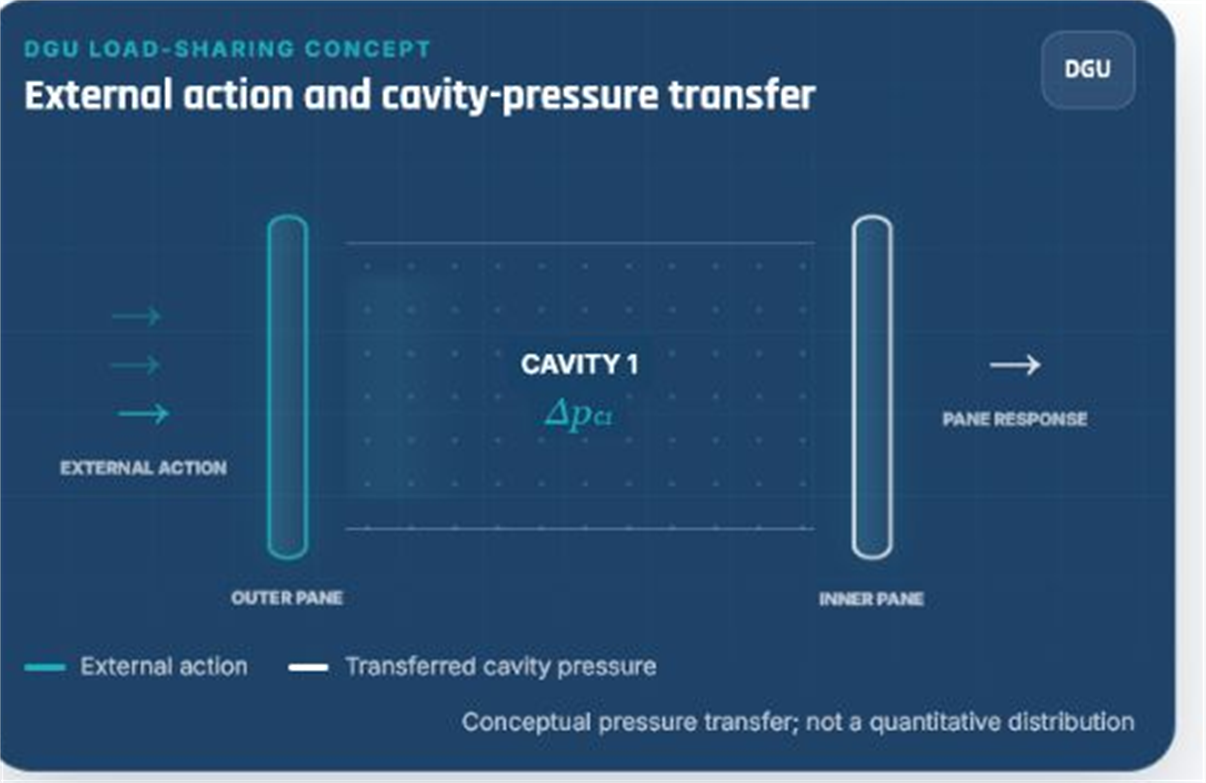
In a DGU, the cavity links the panes through pressure change. Under wind pressure or suction, part of the action may be carried by the directly loaded pane and part may be transferred to the opposite pane depending on pane stiffness and cavity behavior.
Outer Pane and Inner Pane Results
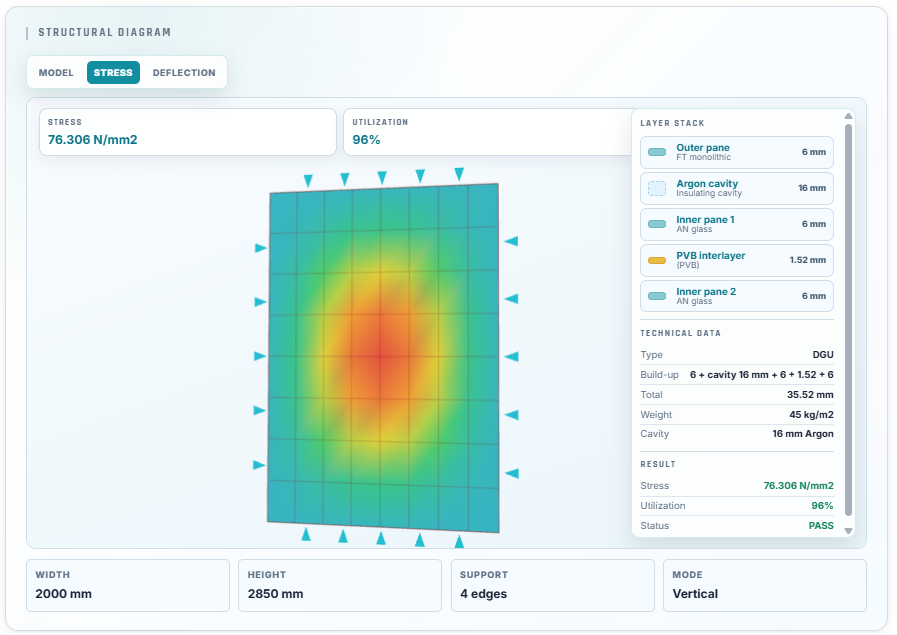
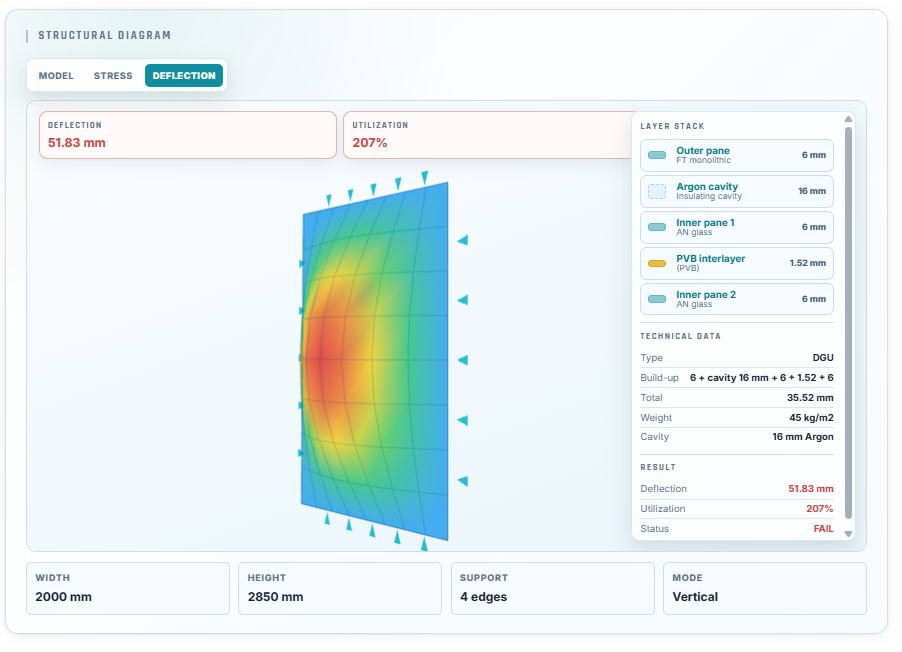
A useful DGU review should identify which pane is being checked and show pane-level stress and deflection output. The governing pane may change between pressure, suction, ULS stress, and SLS deflection cases.
Load Sharing
Effect of Laminated Panes
If one pane is laminated and the other pane is monolithic, their stiffness can be very different. VitraLab uses the relevant laminated-glass equivalent thickness for that pane rather than treating both panes as identical.
Wind Pressure and Wind Suction
Positive and negative wind actions can produce different pane effects. The outer pane and inner pane should both be reviewed because suction, pressure, and transferred cavity effects can govern different checks.
Engineering Review
DGU Engineering Basis
This guide explains the load-sharing concept so engineers can understand why the outer and inner panes require separate stress and deflection review. The related glass deflection calculator page explains the serviceability inputs and outputs in more detail.
Engineering Review
Review pane dimensions, cavity thickness, outer and inner pane build-ups, support condition, wind actions, ULS stress, SLS deflection and output warnings. The calculation remains project-specific and does not replace review of the complete insulating-glass system and its supports.
Example Configuration and Load Basis
The worked example uses a vertical 1000 × 2000 mm four-edge supported 10 / 16 / 10 DGU. Both panes are 10 mm annealed monolithic glass, the reference cavity state is 101.325 kPa at 20 °C, and the applied 3 s wind actions are +0.750 kN/m² pressure and −0.500 kN/m² suction.
Example Pane-Pressure Distribution
For positive wind, the cavity pressure increases by 0.338 kPa and the resulting pane pressure components are +0.412 kN/m² on Pane 1 and +0.338 kN/m² on Pane 2. For suction, the cavity-pressure variation is −0.225 kPa and the pane components are −0.275 kN/m² and −0.225 kN/m² respectively.
Example Governing Result and Interpretation
Pane 1 governs both limit states for this input set. The governing ULS case has 3.714 N/mm² stress and 0.149 utilization. The governing SLS case has 0.676 mm deflection against a 15.385 mm limit, giving a ratio of 0.044. Different pane stiffnesses, cavity dimensions, reference states or actions can change the distribution and governing pane.
Worked Example: DGU 10 / 16 / 10
The calculation uses the implemented rectangular-IGU route from the reviewed 2024 prEN 19100-2 draft.
- Pane size
- 1000 × 2000 mm
- Orientation and support
- Vertical, four edges supported
- DGU build-up
- 10 / 16 / 10
- Glass panes
- 10 mm annealed monolithic glass
- Reference cavity state
- 101.325 kPa at 20 °C
- Applied wind actions
- +0.750 / −0.500 kN/m², 3 s duration
- Governing combination
- 1.5 Wind
- Design action
- 1.125 kN/m²
- Calculated response
- 3.714 N/mm² stress, Pane 1
- Utilization or ratio
- 0.149 utilization
- Governing combination
- Wind
- Design action
- 0.750 kN/m²
- Calculated response
- 0.676 mm deflection, Pane 1
- Utilization or ratio
- 0.044 of 15.385 mm limit
For +0.750 kN/m² wind, the pane pressure components are +0.412 kN/m² on Pane 1 and +0.338 kN/m² on Pane 2. For −0.500 kN/m² suction, they are −0.275 kN/m² and −0.225 kN/m² respectively. Pane 1 governs this input set. Open the EC10 calculator to reproduce or change the inputs.
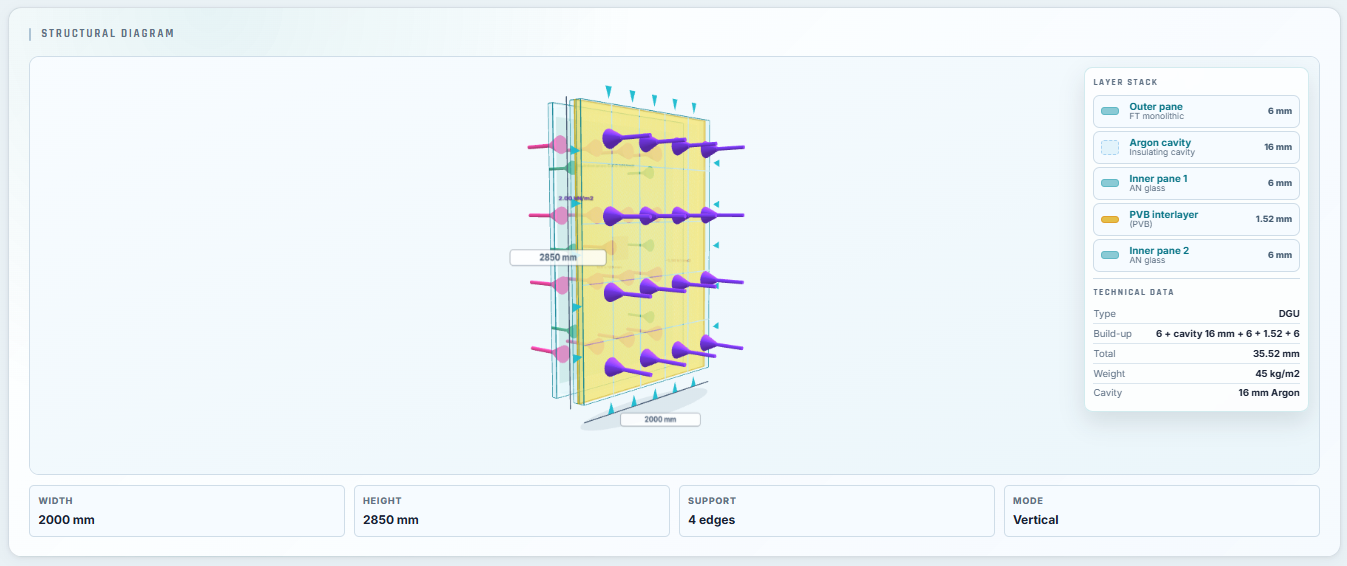
DGU Engineering Figures
Conceptual DGU interaction, followed by examples showing how loads are applied and how pane stress and deflection are reported.
Swipe horizontally to view more figures
Frequently Asked Questions
Does a DGU put all wind load on the outer pane?
Not necessarily. DGU behavior depends on pane stiffness and cavity interaction, so both panes should be reviewed.
Can the inner pane govern a DGU check?
Yes. Depending on stiffness, build-up, pressure or suction direction, and limit state, either the outer pane or inner pane may govern.
Does laminated glass affect DGU load sharing?
Yes. A laminated pane may have different effective stiffness from a monolithic pane, which can affect load sharing and pane-level results.
Should DGU stress and deflection be checked separately?
Yes. ULS stress and SLS deflection are separate checks, and the governing pane or action can differ between them.
Engineering content is prepared and maintained by VitraLab Engineering. Worked examples show how the current calculator treats a defined case; they do not replace project-specific verification.